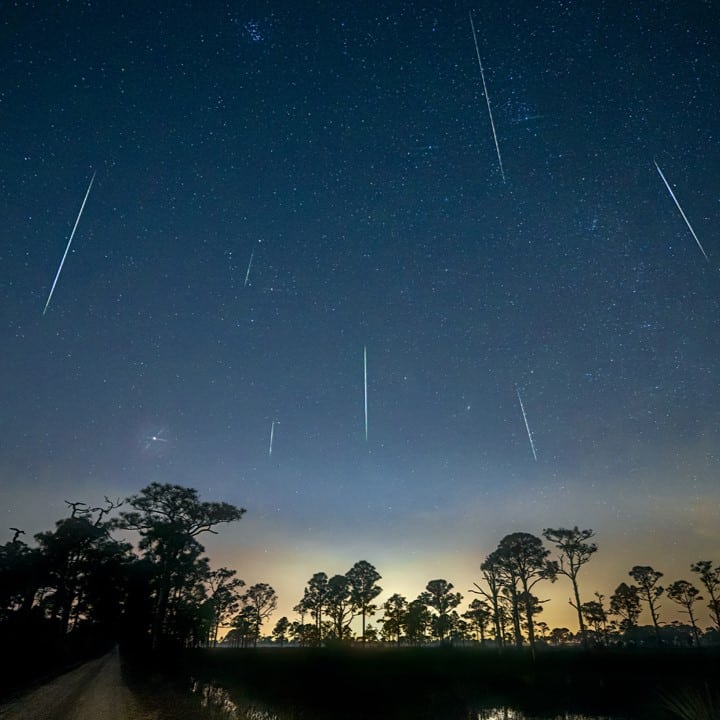
The Geminids are widely regarded as the most reliable and intense meteor shower of the year. Active from 3–19 December, with a peak on the 14th–15th, the Geminids can produce up to 150 meteors per hour under optimal dark-sky conditions. Unlike most meteor showers, which originate from comets, the Geminids are associated with the asteroid 3200 Phaethon, making them scientifically unique. Geminid meteors are known for their slow, bright trails and vivid colours, often appearing yellow, green, or blue.
Because the Geminids peak during Southern Hemisphere summer, they are particularly well-suited to warm, late-night observing sessions in New Zealand. For immersive viewing opportunities, guided experiences and curated dark-sky locations are detailed here: https://socialnaturemovement.nz/meteor-showers-and-cosmic-events/
The Quadrantids are active from 27 December to 11 January, peaking sharply on the 3rd–4th of January, with rates of up to 80 meteors per hour. This shower is known for its brief but intense peak, meaning timing is critical. Quadrantid meteors are fast, bright, and often leave persistent trails, making them highly rewarding for experienced observers.
Named after the now-obsolete constellation Quadrans Muralis, the Quadrantids are associated with asteroid 2003 EH1, reinforcing the growing scientific understanding that meteor showers are not exclusively comet-derived. For those planning early-year stargazing or New Year cosmic experiences, practical viewing guidance is available at: https://socialnaturemovement.nz/meteor-showers-and-cosmic-events/
The Lyrids, active from 14–30 April and peaking on 22nd–23rd April, are one of the oldest recorded meteor showers, with observations dating back over 2,700 years. Producing up to 18 meteors per hour, the Lyrids are more subtle but highly atmospheric, occasionally delivering bright fireballs and sudden bursts of activity.
Originating from Comet Thatcher (C/1861 G1), Lyrid meteors are typically fast and white, often appearing near the constellation Lyra. Their historical significance and gentle cadence make them ideal for reflective, educational stargazing experiences. Seasonal planning and guided night-sky interpretation can be found at: https://socialnaturemovement.nz/meteor-showers-and-cosmic-events/
The Eta Aquarids are among the most anticipated meteor showers in the Southern Hemisphere. Active from 19–28 May, with a peak on 6th–7th May, they can produce up to 50 meteors per hour. These meteors originate from the debris of Halley’s Comet, one of the most famous celestial objects in human history.
Eta Aquarid meteors are exceptionally fast and often leave glowing ion trails that linger in the sky. Best viewed in the pre-dawn hours, they are particularly well-placed for Auckland and northern New Zealand. For optimal viewing locations and curated experiences, explore: https://socialnaturemovement.nz/meteor-showers-and-cosmic-events/
The Perseids are the most internationally recognised meteor shower, active from 17–24 August and peaking on 13th–14th August, with rates reaching up to 100 meteors per hour. Originating from Comet Swift–Tuttle, Perseids are famed for their bright, fast meteors and frequent fireballs.
While Perseids favour the Northern Hemisphere, they are still observable from parts of the Southern Hemisphere under dark skies. Their popularity has made them a cornerstone of global stargazing culture and astro-tourism itineraries. Viewing insights and Southern Hemisphere adaptations are available here: https://socialnaturemovement.nz/meteor-showers-and-cosmic-events/
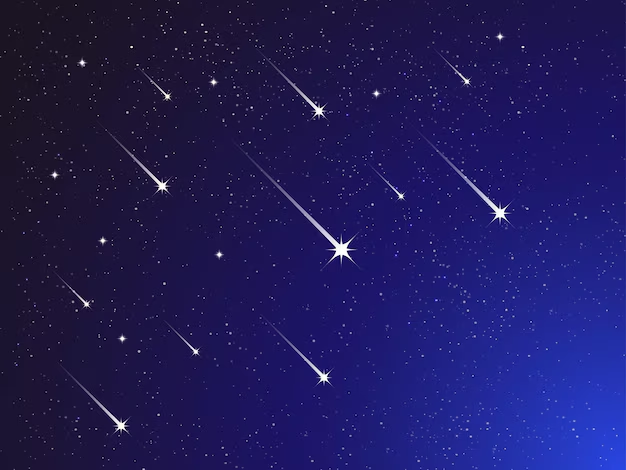
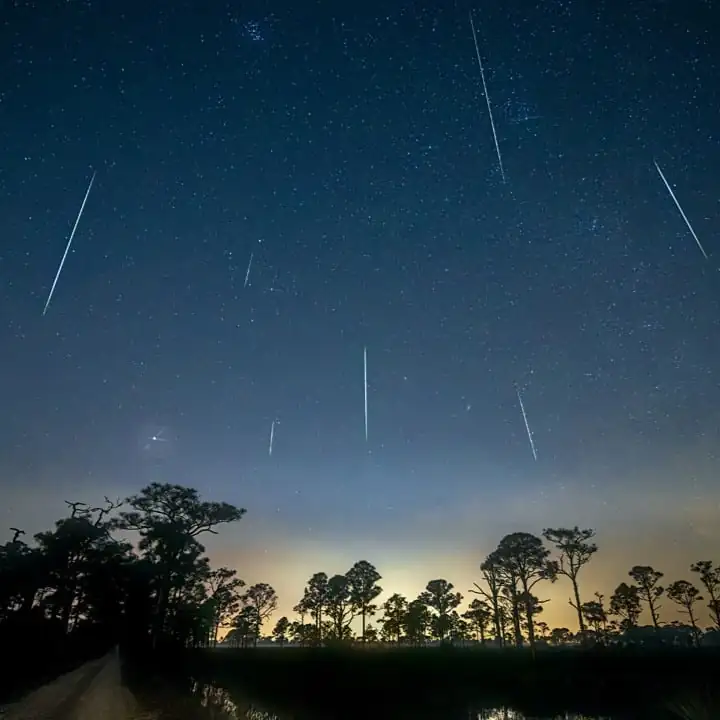
The Orionids, active from 1 October to 6 November and peaking on 21st–22nd October, produce up to 20 meteors per hour. Like the Eta Aquarids, they originate from Halley’s Comet, offering observers another opportunity to witness remnants of this legendary visitor.
Orionid meteors are fast and bright, often creating long, graceful arcs across the sky. Their extended activity window makes them ideal for flexible travel planning and multi-night stargazing experiences. For timing, moon-phase considerations, and guided options, visit: https://socialnaturemovement.nz/meteor-showers-and-cosmic-events/
The Leonids run from 5–29 November, peaking on 18th–19th November, with average rates of up to 10 meteors per hour. While typically modest, the Leonids are famous for producing rare meteor storms, during which rates can surge into the thousands per hour.
Associated with Comet Tempel–Tuttle, Leonids are exceptionally fast and dramatic. Even in quieter years, their historical legacy and potential make them compelling for seasoned skywatchers. For Leonid monitoring and storm-year insights, see: https://socialnaturemovement.nz/meteor-showers-and-cosmic-events/
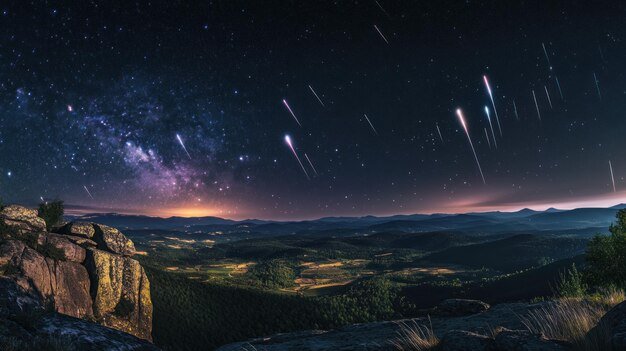
For up-to-date meteor shower calendars, Southern Hemisphere visibility, guided stargazing experiences, and immersive astro-tourism opportunities, explore: https://socialnaturemovement.nz/meteor-showers-and-cosmic-events/