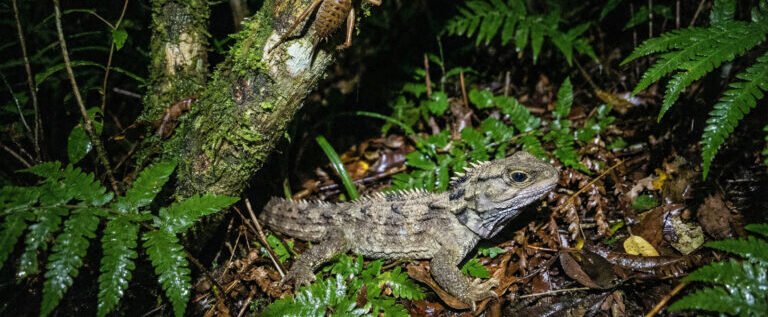
Wētāpunga and the Night Creatures of Tiritiri Matangi
WĒTĀPUNGA: NEW ZEALAND'S GIANT WĒTĀ
Wētāpunga are the largest wētā species in New Zealand, and one of the heaviest insects in the world. Adult females can weigh more than a small mouse and measure the length of an adult hand including the legs. They are gentle, slow-moving, and almost entirely vegetarian, feeding on leaves and fruit from the forest canopy.
Wētāpunga were nearly lost from the New Zealand mainland and survived only on a single island near Aotea Great Barrier. They have since been translocated to Tiritiri Matangi as part of the species recovery programme, and the population on the island is healthy and breeding. Seeing one on the night walk is genuinely special.
GECKOS, SKINKS, AND OTHER REPTILES AT NIGHT
Several species of gecko and skink share the night spaces on Tiritiri Matangi with the more famous tuatara. Pacific geckos, common geckos, and the larger forest geckos can sometimes be spotted on tree trunks and rock faces along the bush tracks. The guide will point them out, and they often hold still long enough for a quiet look without needing to handle them.
These smaller reptiles are part of the same restoration story as the tuatara and the kiwi. The island’s pest-free status, maintained since the early nineteen nineties, is what allows them to thrive. They are sensitive to light and noise, so the same red-torch, low-noise approach applies.
MOREPORK (RURU) AND THE SOUND OF THE BUSH
Morepork, ruru, are the only owl species native to New Zealand and they are very active on Tiritiri Matangi at night. Their two-tone call is one of the defining sounds of the nocturnal walk, and on a still night you can sometimes count three or four individuals calling back and forth across the bush around you.
Visual sightings are less common than audio ones, but the guide watches for movement and silhouettes against the sky. Morepork often perch on dead branches near the track edge, and the red torch sometimes catches the reflection of their eyes long enough for the group to take in the moment without disturbing the bird.
WHY THE NIGHT WALK IS WORTH DOING SLOWLY
The temptation on any guided walk is to keep moving. On Tiritiri Matangi after dark, the better strategy is the opposite. The longer the group stands still, the more the bush comes back to life around you. Wētā emerge from the leaf litter, geckos creep down the trunks, and the sound layer thickens with insect and bird calls you missed when you were walking.
If you are deciding between a brisk loop and a slower, more patient pace, choose the slow one. The guides build the route around stopping points for exactly this reason, and the twilight tour is structured to give you the time. The more you let the island set the pace, the more you will see.
Keep Exploring Auckland Kayaking Adventures
From wildlife encounters and twilight paddles to island expeditions and harbour tours, our guides are designed to help you choose the experience that’s right for you. Browse the rest of our collection for expert tips, trip planning advice, and inspiration for your next adventure.